
Whirlpool Refrigerator Not Cooling: Complete Diagnosis Guide
A Whirlpool refrigerator not cooling is worrying because the clock is running on everything inside it. The critical first question is whether the freezer is still cold. That single observation splits the diagnosis in two and tells you whether you are dealing with an airflow problem or a sealed system problem.
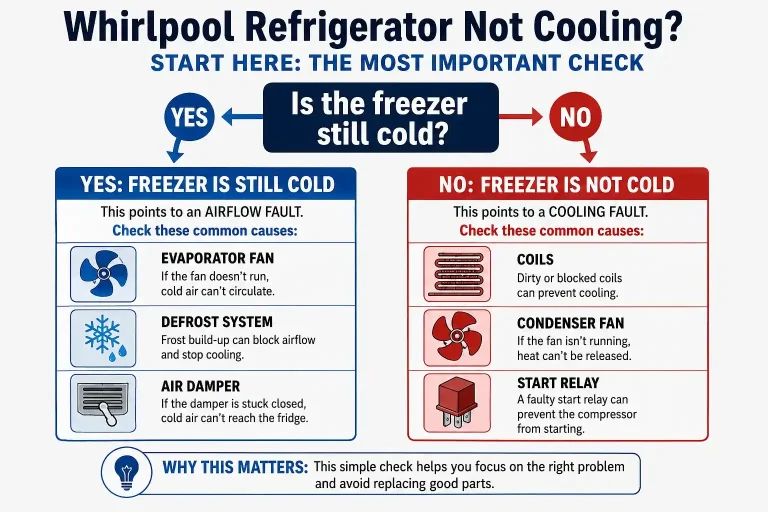
Short version: if the freezer is cold but the fridge is warm, the fault is almost always airflow, meaning the evaporator fan, a defrost failure or the damper. If both compartments are warm, look at the compressor start relay, the condenser fan and the condenser coils.
Start here: is the freezer still cold?
Most Whirlpool refrigerators cool the fridge compartment with air blown from the freezer evaporator. So a cold freezer with a warm fridge is not two faults, it is one: cold air is being made but not delivered.
If both compartments are warm, the machine is not producing cold at all, which moves the diagnosis to the compressor and condenser side.
1. Frost blocking the evaporator (defrost system failure)
This is the most common cause of a cold freezer with a warm fridge. The evaporator coil behind the freezer back panel is designed to frost up and then be melted clear by a defrost heater on a timed cycle. When the defrost system fails, frost builds until it blocks airflow completely.
Remove the freezer back panel and look. A solid wall of ice across the coil confirms it. The underlying fault is one of three parts: the defrost heater, the defrost thermostat or the adaptive defrost control board. Melting the ice with a hairdryer restores cooling for a few days, which is a useful diagnostic confirmation but not a repair.
2. Failed evaporator fan motor
The evaporator fan pushes cold air from the freezer coil into the fridge compartment. When it fails, the freezer stays cold while the fridge warms up steadily.
Open the freezer and listen. You should hear the fan running, and it should stop when you press the freezer door switch. Silence with the door switch held in, or a loud grinding or squealing, points at the fan motor. Also check the fan blade is not simply jammed against accumulated ice.
3. Damper control stuck closed
The damper is a motorised flap that regulates how much cold air passes from the freezer into the fridge. When it sticks shut, the fridge warms while the freezer runs perfectly, sometimes becoming colder than it should.
It is usually found in the upper rear of the fridge compartment behind a cover. A stuck damper is a relatively inexpensive repair compared with sealed system work.
4. Dirty condenser coils
If both compartments are warm, start here because it is free. The condenser coils shed heat from the refrigerant, and when they are packed with dust and pet hair they cannot do it. The compressor then runs constantly without ever reaching temperature.
Coils are usually underneath at the back or behind a rear access panel. Unplug the appliance and vacuum them thoroughly. In a Denton summer this alone accounts for a meaningful share of warm refrigerator calls.
5. Condenser fan failure
The condenser fan cools the compressor and coils. When it stops, the compressor overheats and cuts out on its thermal overload, then restarts once it cools, producing a fridge that cools intermittently and never properly.
With the machine running, you should feel airflow across the condenser area at the back. Nothing there while the compressor is running points at the fan motor or a blade obstruction.
6. Failed compressor start relay
The start relay gets the compressor running. When it fails, the compressor tries to start, draws current, and cuts out on overload, typically producing a clicking noise every few minutes.
A clicking sound from the back of the fridge on a repeating cycle, with no compressor hum settling in afterwards, is the signature. The relay is a comparatively inexpensive part, but the diagnosis needs care because the same symptom can indicate a failing compressor, which is a far bigger job.
7. Control board and thermistor faults
Thermistors report compartment temperature to the main control board. A drifting thermistor can cause the board to stop calling for cooling even though the hardware is fine. These are diagnosed by elimination once the mechanical causes above have been ruled out.
Whirlpool Refrigerator Not Cooling: is it worth repairing?
Cleaning condenser coils costs nothing. Fans, dampers, defrost thermostats and start relays are inexpensive to mid-range and worth doing on most machines. A sealed system fault or a failed compressor on a refrigerator over roughly ten years old is usually the point where replacement makes more financial sense.
Protect your food while you wait
Keep the doors shut as much as possible. A full freezer holds temperature for around 48 hours unopened, a half-full one for about 24. Move anything genuinely perishable to a cooler with ice rather than gambling on it.
When to call a technician for a Whirlpool Refrigerator Not Cooling
If the coils are clean and the fans are running but the refrigerator still will not hold temperature, the fault is in the defrost system, the controls or the sealed system. Sealed system work requires EPA certification to handle refrigerant and is not a DIY repair under any circumstances.
Denton Repair Services connects homeowners across Denton County with local appliance technicians, and you can arrange refrigerator repair in Denton, TX for all Whirlpool models. Because a warm refrigerator puts food at risk quickly, it is reasonable to treat it as an emergency appliance repair.
Our guide to appliance repair prices in Denton will give you a sense of cost, and the full range is on our appliance repair services page.
For model-specific manuals, Whirlpool publishes its own product support documentation.
Call (940) 229-7035 to arrange a diagnosis in Denton County.