
Whirlpool Dryer Not Heating: Causes and Complete Troubleshooting Guide

A Whirlpool dryer not heating is one of the most common faults on the brand, and it is also one of the most predictable. The drum keeps turning, the cycle counts down normally, and the clothes come out warm and damp or completely cold. Because the motor and the heater run on separate circuits, everything can look fine while no heat is being produced at all.
Short version: on electric Whirlpool dryers the usual culprits are the thermal fuse, the heating element, or a half-dead 240V supply. On gas models it is the igniter or the gas valve coils. Almost all of these fail because of restricted airflow, so the vent is where any sensible diagnosis starts.
Check these two things before anything else
Clean the lint filter, then disconnect the exhaust duct from the back of the machine and look for a compacted lint plug. Go outside and confirm the exterior flap actually opens while the dryer runs.
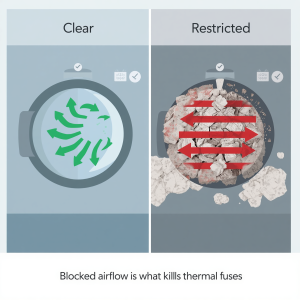
This is not a token step. Whirlpool places the thermal fuse on the blower housing precisely so that it trips when airflow drops. Replace the fuse without clearing the duct and you will be replacing it again inside a few months.
1. Half the power supply is missing
An electric Whirlpool dryer runs on 240V, delivered as two 120V legs. The drum motor, light and control panel run off one leg. The heating element runs off the other. Lose one leg and the machine tumbles perfectly while producing no heat whatsoever.
A double-pole breaker can trip on one side only and still sit in what looks like the ON position, so switch it fully off and back on rather than trusting the handle. In older Denton homes with a fuse panel, check both cartridge fuses, not just one.
2. Blown thermal fuse
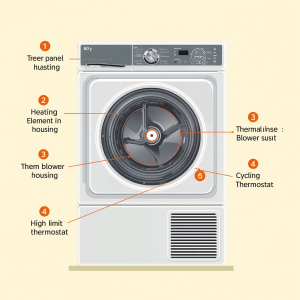
This is the single most common cause of a Whirlpool dryer not heating. The thermal fuse is a one-shot safety device mounted on the blower housing, and once it blows it never resets.
It tests as simple continuity, so a multimeter gives an unambiguous answer: continuity means good, nothing means blown. The important part is what comes next. A blown thermal fuse is a symptom, not a cause. Something made the dryer overheat, and in the overwhelming majority of cases that something is a blocked vent.
3. Burned-out heating element
The element is a coiled resistance wire inside a metal housing on the back of the cabinet. It fails from age, from surges, or from running hot because of poor airflow.
Look for a visible break in the coil or scorching on the housing. Electrically, a healthy Whirlpool element reads roughly 10 to 15 ohms. An open circuit confirms it has failed. Coils sometimes sag and short against the housing instead of breaking, which produces constant heat rather than none, so check for that too.
4. Failed cycling thermostat or thermal cut-off
Whirlpool commonly pairs a cycling thermostat with a high-limit thermostat and a thermal cut-off on the element housing. The cycling thermostat switches the element on and off to hold temperature. When it fails open, the element never energises.
The giveaway is inconsistent heat rather than no heat: clothes come out warm but never dry, or the dryer heats for the first part of the cycle and then stops. Because these parts fail together, most technicians replace the thermostat and cut-off as a kit rather than one at a time.
5. Restricted airflow
Airflow is the root cause behind most of the failures above. Lint packs into the duct, the exterior flap sticks shut, or a long run with several elbows chokes the exhaust. Heat builds with nowhere to go and the safety devices do exactly what they were designed to do.
Warning signs are a hot cabinet exterior, a faint burning smell, and cycle times that have crept steadily longer over months. The fix is clearing the entire duct run, not just emptying the lint trap.
6. Gas models: igniter and gas valve coils
If yours is a gas Whirlpool, ignore the heating element completely. Watch the burner through the inspection port. If the igniter glows bright orange and then the flame never lights, the gas valve coils have failed, and they are almost always replaced as a pair. If the igniter never glows at all, the igniter itself or the flame sensor is at fault.
Gas work is not a DIY repair. Opening a gas valve assembly without training risks a leak or a fire, and gas appliance work in Texas should be carried out by a qualified technician.
7. Control board faults
On newer Whirlpool models with electronic controls, the board decides when to call for heat. Board failure is genuinely rare and is usually diagnosed by elimination, after the fuse, element and thermostats have all tested good. Be sceptical of any diagnosis that jumps straight to the board, because it is the most expensive part in the machine.
Whirlpool Dryer Not Heating: is it worth repairing?
A thermal fuse or thermostat kit is an inexpensive part and worth doing on almost any machine. A heating element is a mid-range repair and still sensible on a dryer under roughly eight years old. A failed control board on an older dryer is usually the point where replacement makes more financial sense than repair.
When to call a technician for a Whirlpool Dryer Not Heating
If you have cleared the vent and reset the breaker and the dryer still will not heat, the fault is a component that needs testing and replacement. That work involves line voltage and, on gas machines, a live fuel supply.
Denton Repair Services connects homeowners across Denton County with local appliance technicians, and you can arrange dryer repair in Denton, TX for gas and electric models alike. If the dryer smells hot or the cabinet is uncomfortable to touch, stop using it and treat it as an emergency appliance repair.
It is also worth reading our guide to appliance repair prices in Denton before committing to a repair, or browsing the full range of appliance repair services.
For model-specific manuals and part numbers, Whirlpool publishes its own product support documentation.
Call (940) 229-7035 to arrange a diagnosis in Denton County.