
GE Dryer Not Heating: Gas and Electric Diagnosis Guide
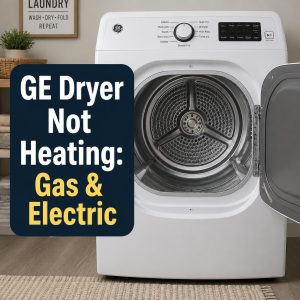
A GE dryer not heating is nearly always a straightforward fault, because GE keeps its heating circuit simpler than most competitors. The drum turns, the timer advances, and the clothes come out cold. On these machines the parts count in the heating circuit is small, which makes elimination fast once you know the order to work through.
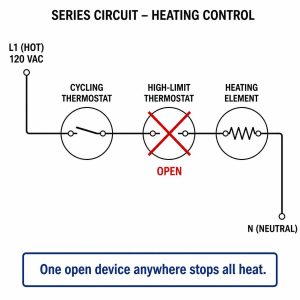
Short version: on electric GE dryers the heating element and the pair of thermostats behind the back panel account for most no-heat faults. On gas models it is the igniter or the valve coils. GE puts several safety devices in series, so one open component anywhere in that chain stops heat entirely.
Two checks before you open anything
Clean the lint filter, pull the exhaust duct off the back of the machine and look for a compacted lint plug, then confirm the exterior flap opens while the dryer runs.
GE mounts its high-limit thermostat directly on the heater housing. Restricted airflow trips it quickly, and if you replace parts without clearing the duct you will be back at the same fault within months.
1. Half the power supply is missing
Electric GE dryers run on 240V supplied as two 120V legs. The motor, drum light and timer run off one leg; the heating element runs off the other. Lose one leg and the dryer tumbles perfectly while producing no heat at all.
Switch the double-pole breaker fully off and back on rather than trusting its position, because one side can trip while the handle still looks normal. In older Denton properties with a fuse panel, check both cartridge fuses.
2. Burned-out heating element
This is the most common cause on electric GE dryers. The element is a coiled resistance wire inside a metal can behind the rear panel, and it is genuinely accessible compared with the sealed assemblies other brands use.
Look for a visible break in the coil or scorching on the can. A healthy GE element usually reads in the region of 10 to 20 ohms. An open circuit confirms failure. Coils can also sag and touch the housing, which causes constant heat rather than none, so check for contact as well as breaks.
3. Open thermostats in the safety chain
GE typically runs a cycling thermostat and a high-limit thermostat in series with the element. Because they are in series, a single open device anywhere in the chain cuts all heat, and each one has to be tested individually.
All of them test as simple continuity. The high-limit thermostat is the one that most often opens, and when it does it is telling you the machine overheated, which points back at the vent rather than at the thermostat itself.
4. Restricted airflow
Airflow is the underlying cause behind most component failures on these machines. Lint compacts in the duct, the exterior flap sticks shut, or a long run with several elbows chokes the exhaust. Heat accumulates and the safety devices open exactly as designed.
The signs are a hot cabinet, a faint burning smell, and cycles that have grown steadily longer over months. Clearing the whole duct run is the fix, not just emptying the lint trap.
5. Timer or control faults
On older mechanical GE dryers the timer itself switches the heat circuit, and worn timer contacts can stop heat while the motor circuit continues to work normally. On newer electronic models the control board makes that decision instead.
Either way this should be a diagnosis of last resort. Test the element and every thermostat first, because the timer and the board are the two most expensive parts in the machine and are blamed far more often than they actually fail.
6. Gas models: igniter and valve coils
On a gas GE dryer, ignore the heating element entirely. Watch the burner through the inspection port. If the igniter glows bright orange and the flame never lights, the gas valve coils have failed, and they are replaced as a matched pair rather than individually. If the igniter never glows, the igniter or the flame sensor is at fault.
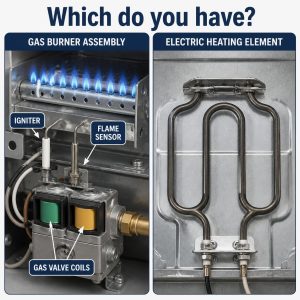
Gas repairs are not a DIY job. Opening a gas valve assembly without training risks a leak or a fire, and gas appliance work in Texas should be carried out by a qualified technician.
GE Dryer Not Heating: is it worth repairing?
Thermostats are inexpensive and always worth replacing. A heating element is a mid-range repair and still sensible on a dryer under roughly eight to ten years old, and GE elements are among the easier ones to access. A failed timer or control board on an older machine is usually where replacement makes more sense than repair.
When to call a technician for a GE Dryer Not Heating
If the vent is clear and the breaker has been reset but the dryer still will not heat, the fault is a component that needs testing under power. That work involves line voltage and, on gas machines, a live fuel supply.
Denton Repair Services connects homeowners across Denton County with local appliance technicians, and you can arrange dryer repair in Denton, TX for gas and electric GE models. If the dryer smells hot or the cabinet is uncomfortable to touch, stop using it and treat it as an emergency appliance repair.
Our guide to appliance repair prices in Denton is worth a look first, along with the full range of appliance repair services.
For model-specific manuals, GE publishes its own product support documentation.
Call (940) 229-7035 to arrange a diagnosis in Denton County.